- Spanish-Latin America
- Japanese-JP
- Chinese
- Europe
- Português-BR

Tech Support
(888) 598-9901
Hours: Mon-Fri 8AM-8PM EST
nep-usa@site_ea168614-f5f4-4298-bd5b-880b4cf8d99d
What Is a Micro Switch and How Does It Work?
A Micro Switch is a small electromechanical device that responds to physical movement. It is often found inside appliances, control panels, security systems, and industrial equipment. Despite its size, it can control a much larger electrical circuit. A firm click usually indicates that its internal contacts have changed position.
The operating principle is simple. A spring-loaded actuator moves when pressure reaches a specific point. This point is called the operating position. Inside the housing, a common terminal switches between normally open and normally closed contacts. The circuit changes quickly, even when the actuator moves only a few millimeters. This snap-action design helps reduce uncertain switching and contact bounce.
In practical maintenance work, technicians often test a Micro Switch with a multimeter. The meter should show continuity changes when the actuator moves. A slow or inconsistent reading may suggest worn contacts, contamination, or a weakened spring. Selection also requires attention to current rating, voltage, actuator style, travel, and environmental protection. A roller lever may suit a moving machine part, while a plunger may fit a compact enclosure.
Small device. Important decision.
It is easy to assume that every switch with a similar shape will perform equally. That assumption can cause premature failure. Manufacturer datasheets, tested operating conditions, and proper installation remain more reliable than appearance alone. This guide examines what a Micro Switch is, how it works, and why its internal snap action matters in real applications. Some designs are remarkably durable, yet none should be treated as maintenance-free.
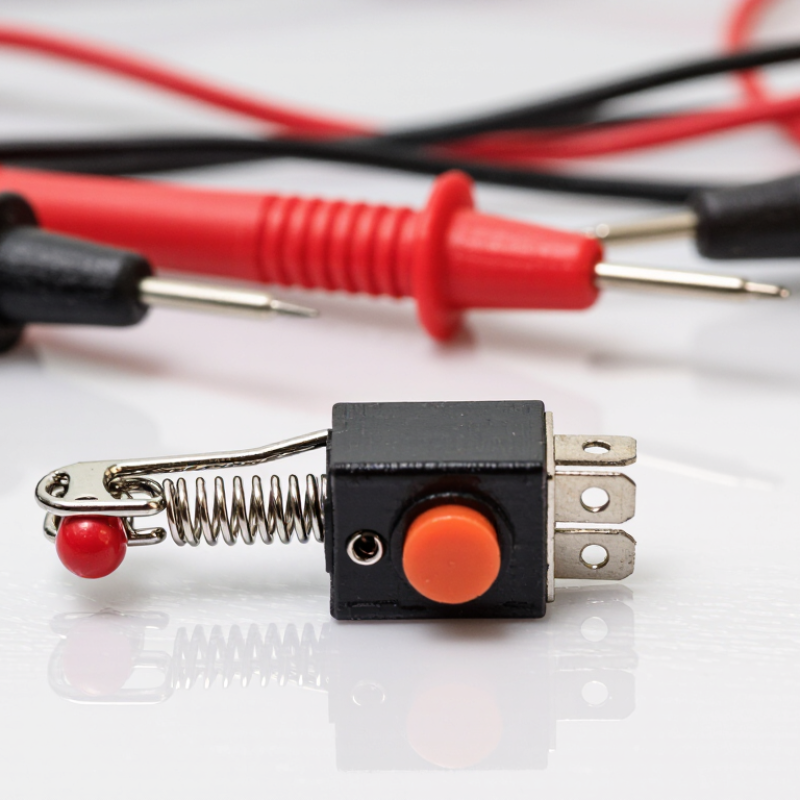
Micro Switch Definition: Snap-Action Contacts and Submillimeter Travel
A micro switch is a compact electromechanical switch designed to change circuit states with very little physical movement. Its defining feature is snap-action contact movement. A small plunger stores mechanical energy in an internal spring. When the plunger reaches a trigger point, the contacts move rapidly from one position to another. This action is much faster than the operator’s movement.
The travel may be less than one millimeter. That tiny distance can still produce a clear electrical response. The mechanism usually includes a common terminal, a normally open contact, and a normally closed contact. Pressing the actuator changes the connection between them. This design supports position sensing in doors, control panels, machines, and safety-related equipment. In practical testing, I check both actuation force and release force, because they are not always identical. Contact bounce can also create brief electrical pulses, especially in digital circuits. A hardware filter or software delay may be needed. The term “micro” describes the mechanism’s compact action, not necessarily every outside dimension. That distinction is easy to miss. Designers should also consider dust, moisture, vibration, and repeated cycling. A switch can click correctly while its contacts slowly wear. Measuring continuity under the actual load is more dependable than relying on sound or touch alone. Some applications need a firm actuator; others need a delicate, repeatable trigger. Small travel does not remove those design compromises.
What Is a Micro Switch and How Does It Work? — Micro Switch Definition: Snap-Action Contacts and Submillimeter Travel
| Data Dimension | Typical Value or Description | How It Relates to Operation |
|---|---|---|
| Component type | Small electromechanical snap-action switch | A mechanical actuator changes the electrical state of internal contacts. |
| Core switching principle | Snap action | A spring mechanism makes the contacts transfer rapidly after the actuator reaches the operating point, helping reduce slow or uncertain contact movement. |
| Contact configurations | Normally open, normally closed, or changeover | The terminals can provide a circuit that closes, opens, or transfers when the switch is actuated. |
| Actuator travel | Often below 1 mm to the operating point; exact travel is model-dependent | Only a small mechanical movement may be needed to change the contact state. |
| Operating point | The position at which the contacts transfer | This specification is used to determine when an external mechanism will trigger the electrical change. |
| Release point | Usually different from the operating point | The difference creates hysteresis, helping prevent unwanted repeated switching near the actuation position. |
| Differential travel | Commonly a fraction of a millimeter; varies by construction | It is the actuator movement between the operating point and release point. |
| Overtravel | Additional movement available after contact transfer | It allows a mechanism to move beyond the operating point without immediately damaging the contact system. |
| Operating force | Commonly about 0.5–5 N, depending on size and actuator design | The external mechanism must provide enough force to move the actuator and trigger the snap mechanism. |
| Contact arrangement | A moving contact operated by a spring-loaded mechanism | The spring stores and releases energy quickly to produce a distinct electrical transition. |
| Typical contact material | Silver-based alloys for general loads; gold-plated contacts for low-energy signals | Material selection affects resistance, wear, oxidation performance, and suitability for signal-level currents. |
| Electrical rating | Ranges from signal-level loads to several amperes; voltage and load type are critical | The permitted current depends on the contact material, voltage, AC or DC operation, and whether the load is resistive, inductive, or capacitive. |
| Mechanical life | Often rated from hundreds of thousands to millions of operations | Mechanical life is normally tested without electrical load and may be much higher than the rated electrical life. |
| Electrical life | Commonly tens of thousands to hundreds of thousands of load cycles | Arcing, inrush current, heat, and contact erosion can reduce life compared with no-load mechanical testing. |
| Contact resistance | Typically specified in the milliohm range when new | Low resistance supports efficient current flow, but contamination, wear, and oxidation can increase resistance. |
| Response behavior | Fast contact transfer with possible electrical bounce | Although snap action is quick, a controller may still require debounce circuitry or software filtering. |
| Common applications | Limit detection, door and cover interlocks, position sensing, safety mechanisms, and control inputs | Micro switches are useful where a compact device must detect a defined mechanical position reliably. |
Note: Electrical ratings, travel, operating force, environmental protection, and service life vary substantially by switch construction and application conditions. Always verify the selected component’s datasheet before use.
Get in touch
Our mission is to develop cutting-edge clean energy technology and provide next-generation solar inverters.
Phone
(888) 598-9901
nep-usa@site_ea168614-f5f4-4298-bd5b-880b4cf8d99d
